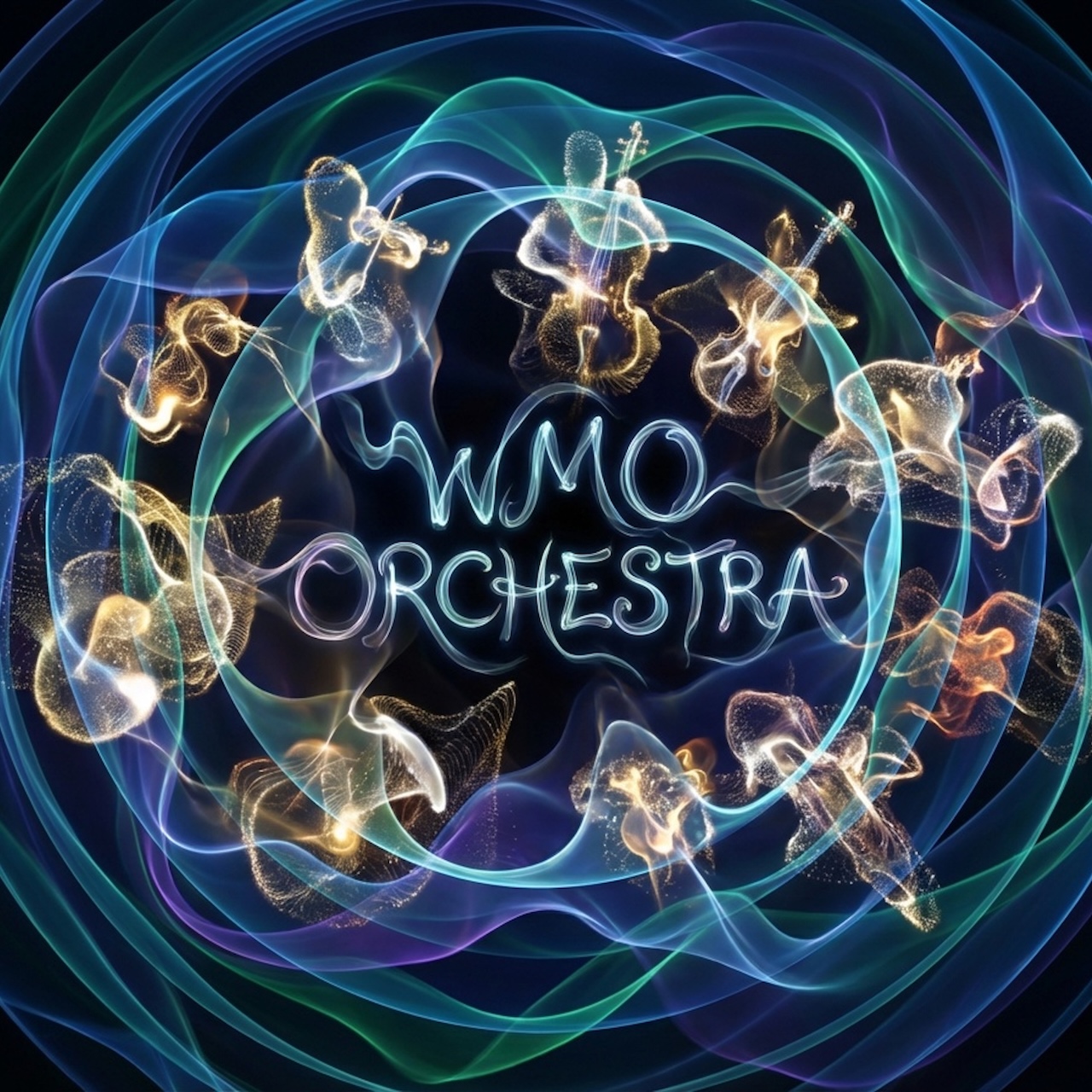
WMO Orchestra is a five-movement experimental music work exploring how musical structure can emerge, transform, and persist without being explicitly imposed.
The project investigates phase, time, pitch, and erosion as compositional conditions rather than expressive goals. Instead of thematic development or harmonic resolution, each movement applies a minimal set of constraints and observes how perceptual coherence arises through repetition, interference, and memory.
The work is presented as a recorded album, accompanied by a written essay that situates the piece within broader aesthetic and artistic discussions.
AVAILABLE SOON
Message wmoorchestra@protonmail.com for details
The album unfolds across five movements. Each movement is self-contained: it begins without introduction and ends without fade. There is no preparatory framing within the sound itself. What exists does so only while it is sounding.

A single minimal pattern is repeated across multiple entries, each starting at a different point in its cycle. No global alignment is enforced. Identity emerges not through repetition, but through displacement.
The pattern remains constant while traversal speed varies. All layers share a common temporal space, yet each experiences time locally. Complexity arises through temporal interference rather than added material.

Pitch is treated as a relational field rather than a harmonic destination. Identical structures are projected across different registers, allowing resonance and colour to emerge as by-products of overlap.

As the pattern propagates, successive lines are anchored to fixed points rather than fully restated. Through overlap and self-interference, the material progressively obscures its own articulation. The pattern remains present, but no longer fully audible. Recognition increasingly depends on memory and expectation rather than direct perception.
The final movement brings all prior conditions together. Phase, pitch, time, decay, and interference are introduced selectively, in response to emergent interactions rather than fixed rules. Coherence appears briefly, not because it is constructed, but because enough context has accumulated to allow it.
The work was composed manually using a minimal piano interface and stock instruments, without score, metronome, or external system. Instrument choice and voicing were guided by availability rather than orchestral optimisation.
The aim was not to refine material, but to observe how structure behaves when introduced with minimal aesthetic intervention.
Despite this restraint, the resulting work remains listenable and internally coherent, a result that prompted further reflection rather than resolution.
An accompanying essay expands on the work from an aesthetic perspective, focusing on perception, memory, authorship, and the limits of formal control. Rather than proposing a new theory, the text engages existing artistic and philosophical discussions by treating the composition itself as an enacted question. Download essay (PDF).
Composer / Songwriter / Producer / Performer: Rodrigo Jazinski
© 2026 JZNSK LTD — All rights reserved.